Discover how breathwork uses intentional breathing to influence the body and mind, what happens during a session, and the effects participants may experience
It sounds simple: breathing. But in the wellness space, breathwork is becoming something much bigger. If you have ever wondered what it actually is (and why people swear by it), this is your entry point. We spoke to founder of IMD Breathwork, Brendon Hansford, to understand what it is, how it works and more.
1Twenty80: What exactly is breathwork?
Brendon: At its core, breathwork is the intentional use of breathing patterns to create real, measurable changes in your body and your brain. Most of us are breathing wrong, and we have been doing it our whole lives without realising. We breathe shallow, fast, into our chest, and that pattern keeps our nervous system locked in a low-grade stress state.
The reason breath is so powerful is that it is the only function in your body that is both automatic and under your conscious control. Your heart rate, your digestion, your hormones, you cannot just decide to change those. But your breath? You can take control of it right now, and within minutes, your entire physiology starts to shift.
When you breathe with intention and guidance, you directly change your chemistry. Your CO2 and oxygen balance shifts, your nervous system responds, your brain enters a completely different state. We use that access point to create what we call a neurological reset. By consciously changing the way you breathe, we shift the CO2 levels in your body, which directly triggers your autonomic nervous system to move from sympathetic, your fight or flight state, into parasympathetic, which is rest and digest. A biological switch. And once that switch flips, the body finally feels safe enough to let go.
1Twenty80: How is breathwork different from meditating?
Brendon: Meditation asks you to observe your thoughts, find stillness, be present. And that is genuinely powerful. But if your nervous system is not ready, meditation can actually feel like you are trying to force something that your body simply is not capable of yet. You cannot think your way into calm when your system is running a threat response.
Breathwork is a guided neurological process. We are not asking you to clear your mind or find stillness. All you need to do is focus on the breath and allow the body to do the rest. The breath changes your chemistry, your chemistry changes your state, and your state changes everything. The body leads, and the mind follows. Not the other way around.

1Twenty80: Can you share more about how your approach is ‘science-backed’?
Brendon: IMD is built on three evidence-based pillars.
- Pillar 1: Breath and the Autonomic Nervous System
When you breathe in a conscious connected pattern, you are directly manipulating your body’s chemistry. CO2 drops in the blood, and because of the Bohr Effect, the haemoglobin holds onto oxygen rather than releasing it. That reduction in oxygen reaching the brain creates a state of cerebral hypoxia. The prefrontal cortex, your rational thinking mind, gets bypassed, and we get direct access to the limbic system, the emotional brain.
In that state, the brain begins releasing chemicals including endogenous DMT. A recent Stanford study found it produced similar neurological results to plant-based medicines.
- Pillar 2: Sound and the Intentional Soundscape
Every sound in an IMD session is intentional. The soundscape is engineered using binaural beats to guide the brain into theta states, where emotional processing and neuroplasticity are at their peak. We layer specific frequencies for nervous system regulation and weave in subliminal messaging to speak directly to the subconscious, alongside live coaching throughout the journey.
- Pillar 3: Somatic Release
The body stores what the mind cannot process. Early experiences do not get recorded as stories. They get stored as feelings. This is why so many of us carry patterns we cannot explain with logic.
When the breath and sound create physiological safety, the body finally gets permission to let go. The crying, the laughing, the heat, the tingling… that is not a side effect. That is your body releasing what it once could not.
1Twenty80: What actually happens in one of your sessions?
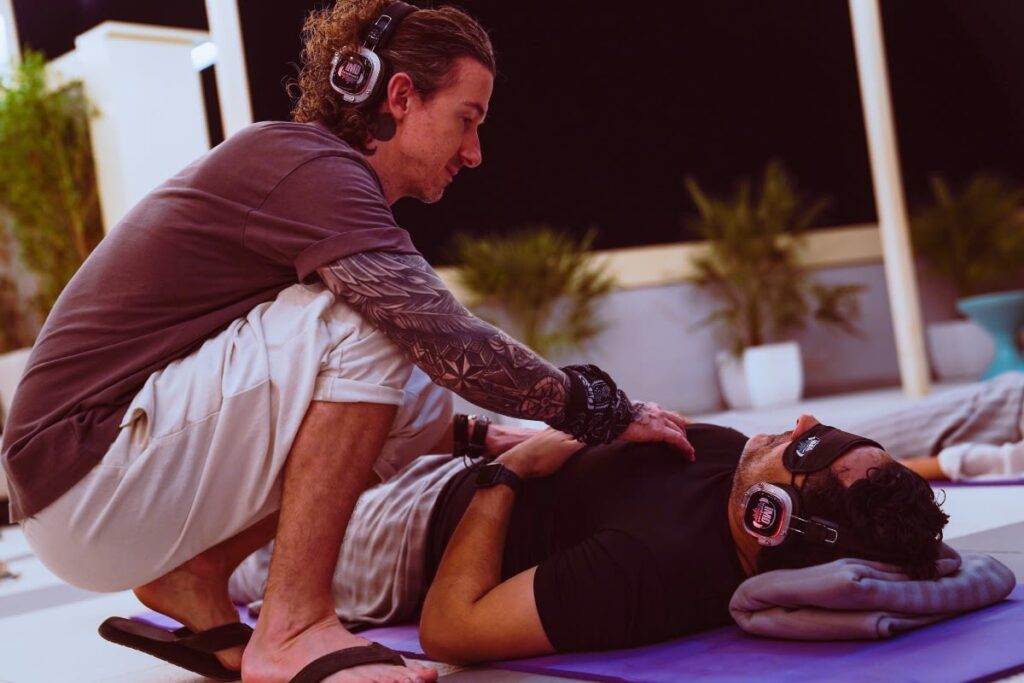
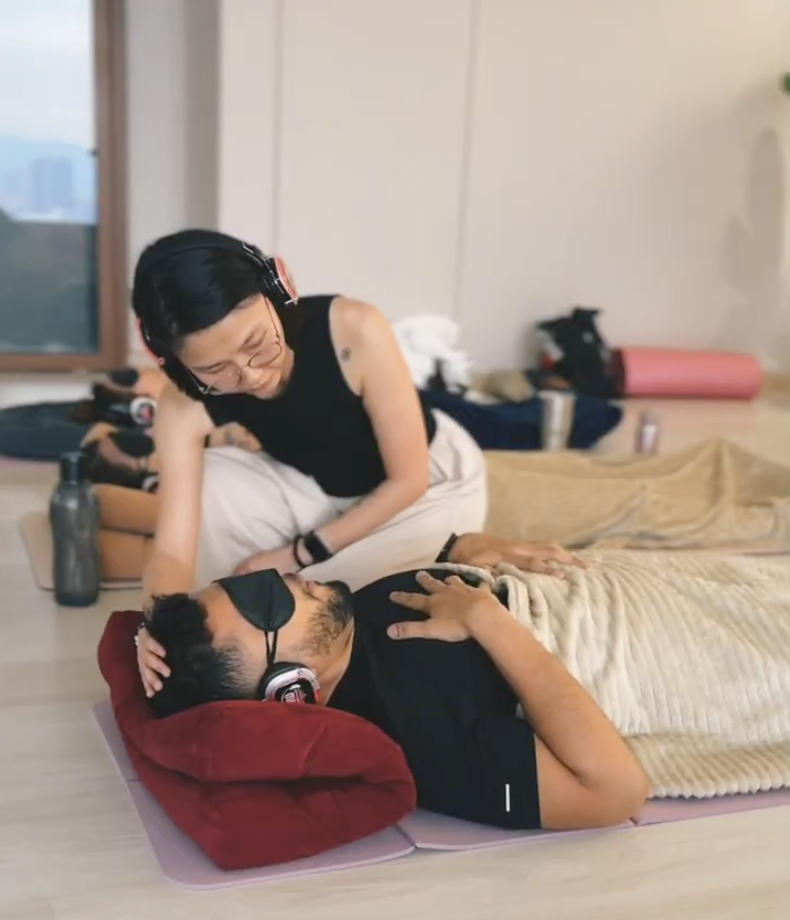
Brendon: You lie down, you put your headphones on, and you close your eyes. Everything is designed to cut off distraction so you can finally focus on yourself. The journey follows a very specific structure. The first part is about bringing things up. We talk through different themes, like loneliness or abandonment, so people can recognise what’s showing up for them. You’re not trying to fix anything yet. Just allow it to come up and actually see it.
Then we move into the breathwork. The first 20 minutes is active breathing, a conscious connected pattern. That’s where things start to shift in the body. You might feel tingling, tension, emotions coming up. That’s the body responding.
After that, we go deeper. The next phase is about confronting it. Looking at how it’s been affecting your life, your decisions, your patterns. Most of these things have been running since you were very young, and you don’t even realise it.
Then we move into a breath hold. This is where the physiology changes quite dramatically. CO2 rises, oxygen gets released into the body, and you enter what’s called an altered state of consciousness. Freud called it boundlessness. It’s a state where you feel safe enough to process things you couldn’t before. The release builds throughout the session, but there’s a peak moment, which is the somatic release. That’s where people might cry, shake, move, or even scream. It’s like shaking up a bottle and finally taking the lid off. The pressure has to come out. After that, there’s a pause, and everything really drops. The body finally lets go.
We usually do two rounds of this.
At the end, we go into integration, which is one of the most important parts. It brings your system back into balance, below your normal baseline. That’s why people feel grounded, still, and present. The biggest thing I hear is, “I feel like myself again.” And that just shows how long people have been living in a state where they didn’t feel like themselves.
1Twenty80: Who is breathwork suitable for?
Brendon: Breathwork as a whole is for everyone. There are many different types of breathwork, and in their different forms they can genuinely benefit every single human being on the planet. Not just yogis or wellness enthusiasts, but anyone living in a fast-paced, high-stress world, and especially those who feel stuck, overwhelmed, or disconnected from themselves. Our downregulation breathwork though? That is truly for everyone, no exceptions. These are gentler, nervous system calming techniques that bring you out of stress and into safety. They slow the heart rate, quiet the mind, regulate the body.
1Twenty80: Is there anyone who should avoid it?
Brendon: The transformational sessions do have contraindications. Anyone who is pregnant, has had recent surgery, or has certain heart,lung, or neurological conditions should avoid the full experience or work with a modified breath pattern. Because of the physiological changes that happen during active breathwork—shifts in CO2, oxygen levels, heart rate and blood pressure—we take safety seriously.

1Twenty80: How does breathwork address generational trauma?
Brendon: Generational trauma lives in the body. It shows up as nervous system patterns, emotional responses that feel disproportionate, and a chronic sense of not being enough. These patterns can be passed on through the environments we grow up in, especially through the behaviours and emotional responses we observe from caregivers. Before the age of seven, the brain is not fully developed to store experiences as clear narrative memories. Instead, they are stored as feelings and body-based responses. Because there is no clear story attached to these experiences, they are difficult to process through thinking alone.
With breathwork, we use the breath to bypass the prefrontal cortex, the part of the brain responsible for rational thinking, and access the limbic system, where emotional memory is held. In this state, we are not analysing or trying to make sense of everything. We are creating a safe environment for the body to process and release what it has been holding. When the nervous system feels safe enough, people often begin to experience emotional or physical release. This can come in the form of crying, shaking, or a sense of relief. Many describe leaving a session feeling lighter, as though something they did not even realise they were carrying has been put down.
In that sense, breathwork is less about revisiting the past, and more about allowing the body to complete processes that may have been interrupted earlier in life.
1Twenty80: What kind of changes do participants typically report after consistent practice?
Brendon: Sleep improves, anxiety lifts, and emotional reactivity settles. The body stops living in survival mode, and real energy returns.
People start making decisions from clarity instead of fear. Focus sharpens, recovery from stress gets faster, and relationships change. You stop reacting and start responding.
Over time, the deeper shifts happen. The stories people have about themselves, like “I am not enough”, or “I do not belong”, start to lose their grip. The first session cracks something open. The consistent practice rebuilds from there. And what people are building is a fundamentally different relationship with themselves.
1Twenty80: There’s a growing wellness space in Malaysia. What makes your approach different?
Brendon: Breathwork is a method, not a personality. We have one global methodology, one safety standard, and one consistent delivery system. Zero shortcuts. Zero improvisation. We work with the nervous system, neuroscience, and decades of research. Everything that happens in an IMD session has a reason.
And in Malaysia, there is so much that people carry silently… the pressure to perform, to be strong, to not show struggle. IMD creates a space where that is not just allowed, it is welcomed. We are building a community of people who are choosing to stop carrying what was never theirs to carry in the first place.